
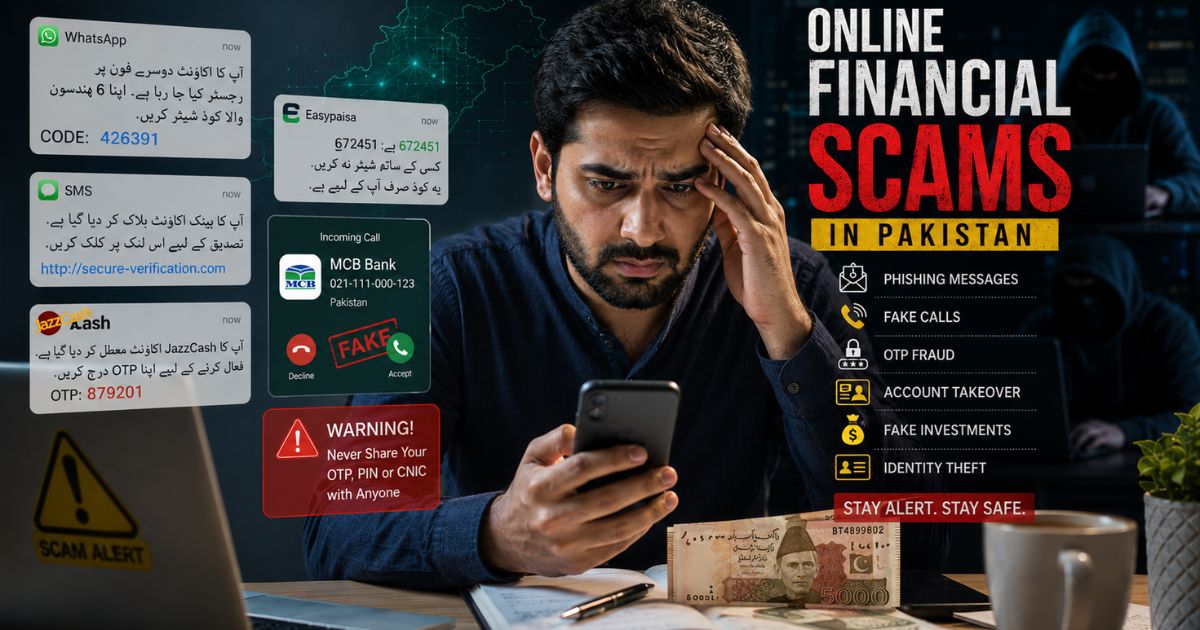
Recently, there has been a sudden increase in attempts of online financial scams in Pakistan through SMS, WhatsApp messages, and phone calls. If you have received a suspicious message asking for your OTP, CNIC, or bank PIN you are not alone. Millions of Pakistanis are facing the exact same threat right now, and many of them have already lost money they could not afford to lose.
Online financial scams in Pakistan have grown from a minor digital nuisance into a full-blown national crisis. As of early 2026, Pakistan loses an estimated $9.3 billion every single year to fraud and digital scams a figure equal to 2.5% of the country’s entire GDP.
To put that in perspective, this loss is actually larger than the $7 billion loan Pakistan received from the International Monetary Fund (IMF). The scale is staggering, and ordinary families not corporations or governments are paying most of that price.
Scammers today are smarter, faster, and far more organized than most people realize. They do not just send poorly written emails anymore. They call you in fluent Urdu, sometimes in your own regional dialect.
They fake the caller ID of your bank so the number looks legitimate on your screen. They pretend to be BISP representatives offering government aid, Courier company representative, asking you to collect parcel. They send messages from what appears to be an official JazzCash or Easypaisa helpline. They create fake websites that look almost identical to real ones. And they use WhatsApp, SMS, and even voice messages to trick you into handing over the one thing they need your OTP.
The frightening part is that these tactics work. Every day, real people in real cities across Pakistan Karachi, Lahore, Peshawar, Quetta, and small towns in between are losing their savings to these schemes.
This article will guide you about the most common online financial scams in Pakistan right now, explain exactly how they work, break down who is most at risk, tell you what legal protections exist, and give you clear, practical steps to protect yourself and your family. Read this till the end, save it, and share it with everyone you care about. Awareness is the single most effective tool we currently have.
Online Financial Scams in Pakistan: The Numbers Are Shocking
Before we get into how these scams work, it is worth pausing to understand just how serious this problem has become at a national level. The data is alarming and it is real.
According to the Global State of Scams Report 2025, published by the Global Anti Scam Alliance in partnership with Feedzai, Pakistan ranks among the top developing countries in the world in terms of GDP percentage lost to fraud. The survey covered 46,000 adults across 42 countries and found that 70% of people globally encountered some form of scam in the past year, with 13% facing attempts every single day. Pakistan’s share of that damage $9.3 billion annually is not theoretical. It comes straight out of the pockets of ordinary citizens.
While the average loss per victim in Pakistan sits at around $139, which may sound small, the cumulative effect is devastating. Millions of people losing relatively small amounts adds up to a national disaster that dwarfs even major government borrowing.
Between 2020 and 2024, the Federal Investigation Agency (FIA) received over 722,000 cybercrime complaints. Of those, fewer than 10% were formally investigated, and only 152 cases ended in actual convictions. In 2024 alone, more than 13,000 complaints of online financial fraud resulted in 1,212 arrests but only 17 verdicts were ultimately delivered. That enormous gap between crimes committed and criminals convicted sends a clear and dangerous message to fraudsters, however the risk of facing real consequences is very low.
In July 2025, the National Cybercrime Investigation Agency (NCCIA) conducted a major operation and dismantled a massive Ponzi scheme running out of a Faisalabad call center, arresting 149 suspects including 48 Chinese nationals and dozens of other foreign actors. Earlier that year, Operation Grey alone resulted in 63 raids and over 450 total arrests. These are significant law enforcement successes. But they are still just a small dent in a much larger problem.
The State Bank of Pakistan (SBP) imposed fines exceeding PKR 776 million on eight major banks in Q1 2024 for failures in anti money laundering, customer due diligence, and fraud risk protocols. The Banking Mohtasib resolved nearly 28,000 digital fraud complaints in 2024, with PKR 1.65 billion recovered in restitution for victims. That sounds like progress until you realize it represents a tiny fraction of the total amount stolen.
Pakistan now has over 120 million social media users, and digital banking and mobile wallet adoption are growing at a rapid pace. JazzCash and Easypaisa together handle billions of rupees in daily transactions, serving tens of millions of customers many of whom are first-time digital finance users with limited experience spotting fraud. Rapid digital growth without matching public education is exactly the environment where scammers thrive, and they know it.
How Online Financial Scams in Pakistan Actually Work
The best protection against any scam is understanding the method behind it. Once you know what to look for, these tricks lose much of their power. Here are the most widespread forms of online financial scams in Pakistan being used right now.
1. Vishing Voice Phishing for Your OTP
Vishing, short for “voice phishing,” is currently one of the most dangerous and widespread tactics behind online financial scams in Pakistan. It is devastatingly simple and extremely effective.
You receive a phone call. The caller is calm, professional, and speaks with authority. They claim to be from your bank, from JazzCash customer service, from Easypaisa support, or sometimes even from the FIA or SBP. They tell you there has been suspicious activity on your account an unauthorized transaction, an account block, a pending verification. They create a sense of urgent crisis and then offer to help you “fix” it.
All they need, they say, is the OTP that was just sent to your phone.
The moment you share that OTP, the scammer has everything they need to transfer your entire balance, change your password, and lock you out of your own account.
According to a cyber security advisory issued by Pakistan’s National Telecommunications and Information Security Board (NTISB), vishing callers specifically ask victims whether they have received a One Time Password from their bank, and then instruct them to share it directly or enter it through a WhatsApp link. They may also ask you to merge the call with an incoming call from your bank a technique that gives them access to your account verification in real time.
One important thing to understand about caller ID spoofing: scammers can make their call appear to come from any number they choose, including your bank’s official helpline. The number on your screen proves absolutely nothing.
The rule here is nonnegotiable, No bank, JazzCash, Easypaisa, or any government agency will ever call you to ask for your OTP or PIN. Not ever, not under any circumstances. The moment someone on a call asks for your OTP, you are being scammed. Hang up.
2. WhatsApp Scams Account Takeovers and Impersonation
Whatsapp based fraud is growing rapidly and has become one of the most reported categories of online financial scams in Pakistan. The Digital Rights Foundation (DRF) helpline received 233 WhatsApp scam reports in just the first half of 2025 alone and experts believe the actual number of cases is far higher, since most victims do not formally report.
One of the most common WhatsApp scams works like this: you receive a call from someone claiming to be from HEC (Higher Education Commission), a courier company, or even a bank. They say there is an urgent matter requiring identity verification. As part of the process, they ask you to share a “six digit verification code” that was just sent to your phone. That code is, in reality, WhatsApp’s account registration OTP. The moment you share it, the scammer registers your phone number on their own device and takes complete control of your WhatsApp account.
Once they control your account, they immediately message all your contacts pretending to be you. They tell your friends, family members, colleagues, and relatives that you are in an emergency stranded, hospitalized, or in trouble and need an urgent money transfer right away. Because the message comes from your actual number and sometimes includes personal touches from your chat history, people trust it and transfer money.
A second variation targets you from the other direction. Your friend or colleague’s WhatsApp account has already been compromised by a scammer. Now that scammer messages you from that familiar account, pretending to be your friend in desperate need. You send money. Your friend never receives it.
Both versions are actively circulating across Pakistan. The DRF advises always enabling two-step verification on WhatsApp and making it a habit to call anyone back on their regular number before sending money, regardless of how convincing their message appears.
3. Fake BISP Support Scams
BISP (Benazir Income Support Programme) scams are a particularly cruel form of fraud because they specifically and deliberately target the most financially vulnerable people in the country families who depend on government assistance for their most basic daily needs.
Scammers design SMS messages to look almost identical to official 8171 BISP communications. These fake messages tell recipients that their payment is pending, their registration has expired, or their account needs urgent reverification. The message includes a phone number to call or a link to click. When the recipient follows through, they are asked to share their CNIC number, mobile wallet PIN, or the OTP sent to their phone.
What makes this scam particularly effective is the psychology at play. Recipients of BISP aid often have limited digital literacy, and the prospect of losing government support creates immediate panic. Scammers count on that panic to override calm thinking. The result is that people who genuinely need that aid money not only lose access to their incoming payment but often lose whatever existing balance they had in their mobile wallet too sometimes losing savings they had built over months.
The rule is clear: The real BISP programme never asks for your PIN or OTP through any SMS or phone call. If you or anyone in your family receives such a message, do not respond. Verify directly through the official 8171 helpline, and report the fraudulent number to FIA at 1199.
4. Fake Investment Schemes
Fake investment scams are among the financially most devastating category of online financial scams in Pakistan, and they are growing more sophisticated with every passing month. These schemes almost always begin on social media Facebook groups, WhatsApp broadcast channels, Instagram ads, or Telegram groups. They promise guaranteed daily returns of anywhere from 5% to 20%, presenting themselves as forex trading platforms, cryptocurrency investment apps, or task based reward apps where you earn money by liking posts, watching videos, or completing simple online jobs.
The first phase always involves building trust. Victims receive small, real payouts. They grow excited. They tell their friends and family. More people join and invest. The scammers use this trust building phase deliberately and patiently, because they know that when they eventually close the platform and disappear, the losses will be enormous.
Reports from across Pakistan document individuals losing up to $55,000 in a single scheme. Others describe investing their entire life savings, taking bank loans, convincing elderly parents to contribute only to see everything vanish overnight when the app stops processing withdrawals, the chat groups go silent, and the operators disappear without a trace.
The Securities and Exchange Commission of Pakistan (SECP) flagged 141 illegal lending and investment apps in 2025 alone. Many of these apps, after being officially taken down, simply reappear under new names within weeks, targeting new victims.
A related variant involves fraudulent loan apps. They offer instant loans at apparently attractive rates. Once a borrower is trapped unable to repay because of undisclosed fees, compounding interest, and escalating charges the harassment begins. These apps call employers, send messages to family members, contact people from the borrower’s phone book, and in some documented cases have sent messages to students’ universities and schools. The psychological and social damage extends far beyond the financial loss.
5. SMS Phishing (Smishing)
Smishing phishing executed through SMS is one of the oldest tricks in the fraud toolkit, but it continues to work because the messages have become far more convincing over time. You might receive a message claiming your bank account has been temporarily suspended, or that a parcel is being held at customs and requires a small fee for release, or that you have been selected for a government prize and must click a link to claim it.
These messages increasingly include personal details your first name, the last four digits of your account number, or a reference number to appear legitimate. The links embedded in them either lead to fake websites that capture your login credentials or to pages that silently install malware on your device, harvesting data from your apps in the background.
Some smishing messages impersonate official institutions the SBP, SECP, NADRA, or the FIA using language that implies legal consequences if you do not respond immediately. This psychological pressure pushes people to click before they think. The solution is always the same: do not click. Go directly to the official app or website instead.
Online Financial Scams in Pakistan: Who Is Most at Risk?
While no one is completely immune, certain groups are specifically and repeatedly targeted by scammers. Understanding who is most vulnerable can help you provide better protection to people around you.
Elderly citizens are consistently among the most targeted victims. They may be less familiar with how digital verification works, more trusting of official sounding callers, and less accustomed to questioning urgency. Scammers write their scripts specifically to exploit this trust. If you have elderly parents or grandparents who use a mobile wallet, have a direct conversation with them about OTP safety.
BISP recipients and social welfare beneficiaries face scams designed precisely around the language and format of government payment systems, mimicking official communications with alarming accuracy.
Young job seekers are targeted through fake online job offers that require upfront registration fees, processing charges, or personal identity documents. Some of these fake opportunities funnel victims into illegal call center operations where they unknowingly become participants in organized fraud networks.
Mobile wallet users the tens of millions of Pakistanis using JazzCash and Easypaisa daily are consistently high value targets because these wallets enable instant, irreversible transfers.
Students are increasingly targeted through fake scholarship schemes, fraudulent task based income apps, and fake part-time job platforms.
People under financial pressure are the most likely to fall for fake investment and loan schemes. When someone is genuinely struggling financially, a promise of guaranteed returns is extraordinarily difficult to resist. Scammers actively identify and approach people in these circumstances through social media and messaging groups.
Online Financial Scams in Pakistan: What the Law Says
Pakistan has established legal frameworks to combat cybercrime. The Prevention of Electronic Crimes Act (PECA) 2016 remains the primary law under which digital fraud is prosecuted. It covers unauthorized access, data theft, electronic fraud, and identity theft, with provisions for significant fines and imprisonment for convicted offenders.
The NCCIA and the FIA Cybercrime Wing are the two main agencies investigating fraud. Both are accessible to the public: the FIA cybercrime helpline operates at 1199, and the PTA complaint center is available at 080055055.
In 2025, the government established the Digital Rights Protection Authority (DRPA) and intensified enforcement operations considerably. Operation Grey resulted in 63 raids and over 450 arrests. The NCCIA dismantled multiple illegal call centers running international scam networks from Pakistani territory.
However, enforcement still falls far short of matching the scale of the problem. With approximately 350 cybercrime investigators handling more than 160,000 annual complaints, each officer carries a caseload of roughly 6,000 cases. Some provinces operate with only two digital forensic units. Conviction rates remain critically low. Jurisdictional overlap between the FIA and NCCIA has created operational delays. And courts, not yet fully trained in digital evidence standards, struggle to process cybercrime cases at the required pace.
All of this means one practical thing: do not wait for the legal system to protect you after the fact. Report every scam attempt your report contributes to investigations and helps build patterns. But your realtime, in the moment protection depends entirely on your own awareness and the decisions you make in that critical instant.
How to Protect Yourself From Online Financial Scams in Pakistan
The encouraging reality is that the vast majority of these scams can be stopped right at the first moment of contact if you know the warning signs and follow simple rules consistently.
Never share your OTP with anyone, ever. This is the single most important rule in digital financial safety in Pakistan today. It does not matter how convincing the caller sounds, how urgent the situation appears, or what official number is showing on your screen. No bank, fintech company, telecom provider, or government agency will ever call you to request your OTP or PIN. That is not how these systems work. If someone asks for it, you are being scammed. Hang up immediately.
Enable two-step verification on WhatsApp. Open WhatsApp, go to Settings → Account → Two-step Verification, and set a six digit PIN. This single action means that even if a scammer somehow obtains your phone’s verification code, they still cannot register your number on their device without your personal PIN. It is one of the most effective and easiest security steps available.
Never click on links in messages you did not request. Whether a link arrives in an SMS, a WhatsApp message, or an email if you did not initiate the contact, do not click. Instead, go directly to the official app or website by typing the address yourself, or call the official helpline number to verify any claim in the message.
Verify before transferring money. If you receive a WhatsApp or SMS message from what appears to be a friend or family member asking for emergency money, call that person on their regular phone number before doing anything else. If their account has been hijacked, a simple voice call will reveal it immediately.
Secure your SIM card against swap fraud. Set a SIM PIN through your phone’s settings. If your mobile phone unexpectedly loses all network signal with no obvious explanation, contact your telecom operator right away it may indicate that someone has fraudulently ported your number to a new SIM.
Monitor your wallet and bank accounts regularly. Review your JazzCash, Easypaisa, and bank account transaction history frequently. Any transaction you do not recognize should be reported immediately to your bank or wallet provider and followed up with a complaint to FIA at 1199.
Be deeply sceptical of guaranteed investment returns. No legitimate investment anywhere in the world offers guaranteed daily or weekly profits. If an app, a social media contact, or a WhatsApp group is promising guaranteed returns especially if small initial payments seem real treat it as a scam regardless of how convincing the platform looks.
Report every attempt. File a complaint with the FIA Cybercrime Wing or NCCIA online or at 1199. Report suspicious calls and messages to the PTA at 080055055. Save screenshots, note call times, and preserve any message records as evidence. Your report may prevent someone else from losing their savings.
Educate the people around you. Scams travel fastest through networks of trust. When you clearly explain to your parents, siblings, domestic staff, neighbours, and colleagues exactly how these tricks work, you create a protective circle around your entire community. Talk about this openly, regularly, and without embarrassment. The more people who understand the mechanics of these scams, the fewer victims there will be.
Final Words on Online Financial Scams in Pakistan
Online financial scams in Pakistan are not slowing down. In fact, they are becoming more sophisticated every year. Scammers now use Ai powered voice cloning tools that can convincingly mimic bank representatives or even family members. They conduct background research on targets before calling. They know your name, your city, your bank, and sometimes even recent transaction details purchased from data breaches or sold by dishonest insiders. They operate with professional scripts, organized teams, and business structures built entirely around defrauding ordinary Pakistanis.
But here is what all of that organization and sophistication ultimately comes down to one single moment. The moment a victim reads out an OTP. Clicks a suspicious link. Transfers money without verifying. That moment belongs entirely to you.
No law enforcement action, no government regulation, and no bank security upgrade will protect you as reliably as your own informed and alert judgment. When you genuinely understand and follow the rules especially the one rule that matters most, that no legitimate institution will ever ask for your OTP you remove the scammer’s most essential tool.
Stay alert. If something feels wrong, it probably is. There is no urgency so great that you cannot take sixty seconds to verify. Hang up. Take a breath. Call the official helpline. Ask a trusted person. The sixty seconds it takes to verify could save you everything.
Please share this article with your friends and family. Forward it to your parents, your siblings, your colleagues, and your neighbours. Post it in your community group. In the ongoing fight against online financial scams in Pakistan, your awareness and the awareness of everyone around you is the most powerful protection available. Use it.
(Author’s Note:
Financial fraud on the internet is growing fast, and sadly, many people only realize it after losing their hard-earned money. From fake investment schemes to online scams and hidden digital manipulation, staying informed has become more important than ever. Small awareness today can save someone from a major loss tomorrow.
If this article helped you understand online fraud better, you might also find these reads useful:
How to Save Money in Pakistan in 2026, A simple and practical ways to manage your money wisely in today’s rising inflation and economic uncertainty.
5 Shocking Ways Food Companies Control Your Mind. An eye-opening article about how companies use psychology and marketing tricks to influence people’s choices and habits.
Daily Electricity Consumption in Pakistan. A detailed breakdown of electricity usage, rising bills, and how everyday consumption quietly impacts household budgets.)
References
- Global Anti-Scam Alliance & Feedzai Global State of Scams Report 2025 https://www.gasa.org
- Profit by Pakistan Today “Pakistan Loses Over $9 Billion to Financial Scams Annually” (October 2025) https://profit.pakistantoday.com.pk
- The Express Tribune “Scams Costing 33% More Than $7B IMF Loan” (October 2025) https://tribune.com.pk
- The Express Tribune “Billion Dollar Digital Fraud: Call for Effective Cyber Governance” (November 2025) https://tribune.com.pk
- Dawn.com “Digital Rights Foundation Issues Alert for Rising Scam Compromising WhatsApp Accounts” (August 2025) https://www.dawn.com/news/1927824
- TechJuice “Pakistan Loses $9 Billion Annually to Financial Scams: Global Report” (October 2025) https://www.techjuice.pk
- National Cybercrime Investigation Agency (NCCIA) Pakistan Financial Fraud Advisory https://www.nccia.gov.pk/financialfrauds.php
- Pakistan Cabinet Division / NTISB Cyber Security Advisory No. 53/2023: Prevention Against Financial Scam https://cabinet.gov.pk
- Digital Pakistan “Pakistan Faces New Wave of Financial Crime Through WhatsApp and Social Platforms” (July 2025) https://digitalpakistan.pk
- ScamWatchHQ “Pakistan Scams 2025: The $9.3 Billion Crisis” (November 2025) https://scamwatchhq.com
- Prokerala / IANS “Pakistan’s Digital Economy Plunges Into Deep Crisis as Online Financial Frauds Soar” (September 2025) https://www.prokerala.com

https://www.threads.com/@adilawan9298