
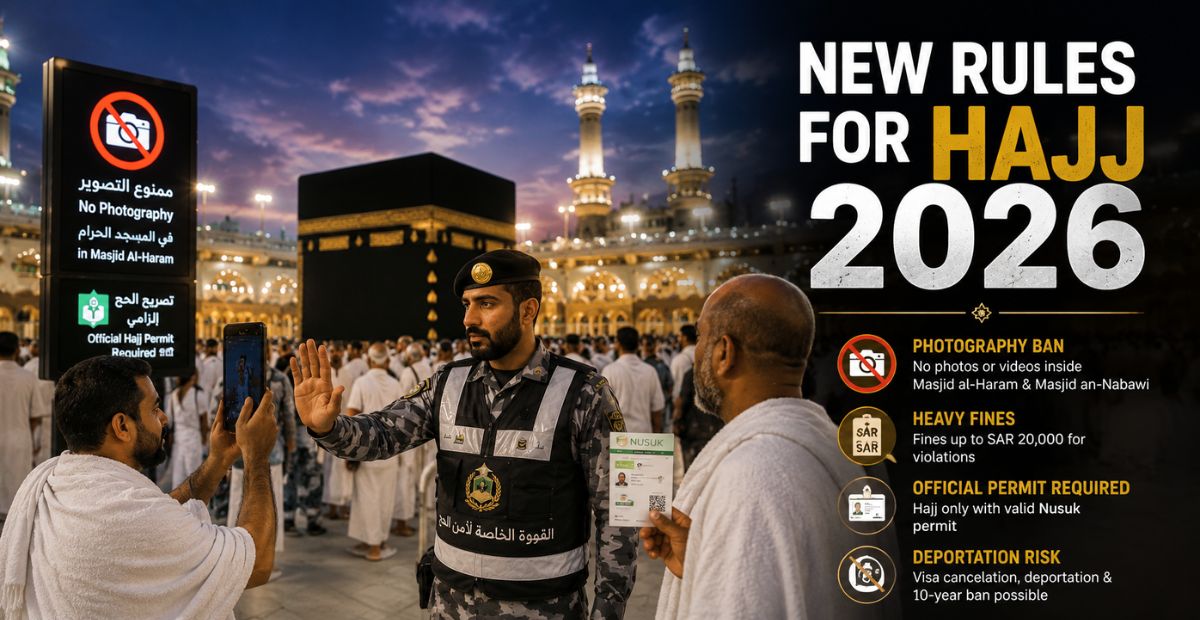
New Rules For Hajj 2026: Complete Guide For Pilgrims
Every year, millions of Muslims travel to Makkah to fulfill one of the five pillars of Islam. This year, the journey comes with a serious set of changes that every pilgrim especially from Pakistan must be aware of before they leave home. Saudi Arabia has introduced the strictest New Rules For Hajj 2026 in the country’s modern history, covering everything from photography bans inside Masjid al-Haram to heavy fines, possible deportation, and tighter controls on who can even enter Makkah.
If you are preparing for this sacred journey, this guide is for you. What are the major changes in rules this year, what are the penalties, and what exactly Pakistan’s Ministry of Religious Affairs has announced for this year’s Hajj quota and policy.
New Rules For Hajj 2026: The Photography Ban That Every Pilgrim Must Know
One of the most talked-about changes this year is the ban on photography and videography inside the two holiest sites in Islam. Saudi authorities have announced that photography and videography are now strictly prohibited inside Masjid al-Haram in Makkah and Masjid an-Nabawi in Madinah during the 2026 Hajj season. Mobile phones, cameras, and all other recording devices fall under this ban. This is not a soft guideline. It is an enforced restriction.
The Saudi Ministry of Interior stated clearly that the ban applies to all pilgrims without any exception. No device is permitted for capturing photos or videos inside the two sacred mosques. The reasoning given by Saudi officials is straightforward, widespread photography causes overcrowding, disrupts the flow of rituals, and breaks the spiritual atmosphere that pilgrims travel thousands of miles to experience.
Think about it from a practical angle. When millions of people stop mid-Tawaf to take selfies, it slows crowd movement and creates safety risks. In 2024, over 1,300 pilgrims most of them without permits died due to extreme heat and overcrowding. Saudi Arabia is taking no chances in 2026.
What Happens If You Take a Photo Inside Haram?
The penalty is severe. Violating the photography rule can result in:
– A fine of SAR 10,000 for unauthorized photography inside holy sites
– Confiscation of your device (mobile phone or camera)
– Arrest by security personnel
– Cancellation of your Hajj visa
– Immediate deportation from Saudi Arabia
Importantly, photography of other people especially those in prayer without their consent remains strictly forbidden under Saudi law regardless of location. Even in areas outside the mosque, pilgrims should be extremely cautious about pointing cameras at others.
The ban also covers Tawaf the circumambulation of the Kaaba. This is one of the most common spots where pilgrims used to take videos. That is no longer allowed.
Some confusion has circulated online about whether personal photography is allowed anywhere. According to fact-checked reports, self-photography in personal settings outside the mosque premises may still be permitted under standard etiquette guidelines, but anything inside the Haram boundary is off-limits. When in doubt, put your phone away. No photo is worth a fine, deportation, and a potential 10-year ban from Saudi Arabia.
New Rules For Hajj 2026: Permit System, Fines & Unauthorized Entry Penalties
Beyond the photography ban, the New Rules For Hajj 2026 bring a much harder crackdown on people attempting to perform Hajj without an official permit. This is arguably the most consequential change for anyone considering cutting corners.
Saudi Arabia has made it crystal clear: you cannot perform Hajj on a tourist visa, Umrah visa, business visa, or visit visa. Only a valid, officially issued Hajj permit verified through the Nusuk system grants you the legal right to enter Makkah and perform the rituals.
Fines for Performing Hajj Without a Permit
The Ministry of Interior has issued the following penalties:
– SAR 20,000 fine (approximately PKR 8.5 lakh or USD 5,300) for any individual caught performing or attempting to perform Hajj without a permit
– SAR 100,000 fine (approximately USD 26,500) for anyone who helps an unauthorized pilgrim including travel agents, drivers, landlords, and accommodation providers
– Deportation from Saudi Arabia
– 10-year re-entry ban meaning you cannot return to Saudi Arabia for work, visits, Umrah, or any future Hajj
Additionally, any vehicle proven to have transported unauthorized pilgrims to Makkah during the Hajj period can be permanently confiscated.
For Pakistani pilgrims, this is especially important to understand. After the 2025 disaster where over 60,000 Pakistani pilgrims could not perform Hajj due to mismanagement and fraudulent operators, the risks of dealing with unofficial agents are very real. Some operators promise shortcuts, claiming they can get you to Makkah via tourist or visit visas. Do not fall for this. The consequences can permanently close the door on future Hajj.
The Nusuk Card: Your Identity in the Holy Sites
A key part of the 2026 enforcement system is the Nusuk Card a digital ID linked to your Hajj permit, accommodation details, and personal data. Every pilgrim must carry this at all times from arrival to departure. Without it, you may be:
– Denied access to transportation and services
– Fined by Saudi authorities
– Detained for verification
The Nusuk Card is also linked to biometric data and facial recognition systems that Saudi Arabia is deploying at airports and entry checkpoints in 2026 as part of its most technology-heavy Hajj operation ever.
Pakistan’s Hajj Quota for 2026: All You Need to Know
Pakistan is one of the largest Hajj-sending nations in the world, and the government has finalized a detailed Hajj Policy 2026 following the chaos of last year’s private scheme failures.
Total Pakistan Hajj Quota 2026
Pakistan’s total Hajj quota for 2026 has been set at 179,210 pilgrims, divided as follows:
– 119,000 seats under the Government Hajj Scheme
– 60,000 seats under the Private Hajj Scheme
The government scheme now accounts for roughly 70% of the total quota a deliberate decision made after Prime Minister Shehbaz Sharif ordered an investigation into last year’s private operator failures, when approximately 60,000 Pakistani pilgrims paid money and then could not travel.
Priority for 2025 Leftover Applicants
Out of the 60,000 private scheme seats, 22,097 seats are reserved for applicants who were left behind in 2025. The remaining 37,903 seats are open to new applicants. This is a welcome and fair step by the Ministry of Religious Affairs, designed to restore trust in the system.
How Much Does Hajj Cost from Pakistan in 2026?
The estimated cost under the government scheme ranges from:
– Long Package (38–42 days): First installment of PKR 500,000, total estimated cost between PKR 1.15 to 1.25 million
– Short Package (20–25 days): First installment of PKR 550,000, with a slightly higher total
Pilgrims are allowed to pay in two installments, which makes the financial burden more manageable. All payments must be made through designated banks.
Who Is Eligible for Hajj 2026 from Pakistan?
The Ministry of Religious Affairs has set the following eligibility conditions:
- Applicants must hold a valid Pakistani passport that does not expire before November 26, 2026
2. Children under 12 years of age are not eligible to perform Hajj in 2026
3. All pilgrims must be vaccinated with Saudi-approved vaccines, including the mandatory meningitis ACYW vaccine
4. Women traveling without a mahram (male guardian) can now perform Hajj, provided they travel as part of a certified, approved group formed by the Ministry. Individual women cannot travel alone they must be part of an officially registered all-women group
Road to Makkah Initiative Extended to Karachi
Pakistan has also expanded the Makkah Route Initiative (Road to Makkah project) to Karachi for 2026, in addition to Islamabad. This project allows pilgrims to complete Saudi immigration and biometric processing in Pakistan before boarding their flight, which significantly reduces delays and crowding at Saudi airports. Around 38,000 pilgrims are expected to benefit from this facility this year. The government is also working on extending it to Lahore in future years.
New Rules For Hajj 2026: Health, Vaccination & Age Requirements
Saudi Arabia has added strict health compliance measures to the New Rules For Hajj 2026, and Pakistan’s Hajj Policy fully aligns with these requirements.
Mandatory Vaccinations
Every pilgrim must provide proof of vaccination for:
– Meningitis ACYW135 mandatory for all pilgrims over one year old
– COVID-19 and seasonal influenza vaccines are strongly recommended
– Any additional vaccines required by Saudi health authorities closer to the travel date
Pilgrims who arrive without valid vaccination certificates can be denied entry or sent to quarantine. Make sure you get your yellow card (vaccination certificate) well in advance and carry it with you throughout the trip.
Age Restrictions
In an important reversal from an earlier proposal, Saudi Arabia confirmed that children above 12 years are eligible to perform Hajj in 2026. A proposal to raise the minimum age to 15 was withdrawn. However, Pakistan’s own policy independently sets the minimum age at 12, so there is no conflict there.
Elderly pilgrims and those with disabilities are being accommodated through dedicated mobile processing systems at airports that reduce queue times.
What Pakistani Pilgrims Must Do Before Leaving
Given all the New Rules For Hajj 2026, here is a clear action list for Pakistani pilgrims:
Documents to Prepare:
– Valid Pakistani CNIC (Computerized National Identity Card)
– Valid passport (must not expire before November 26, 2026)
– Official Hajj visa issued through the government or registered private operator
– Nusuk Card (issued upon registration carry at all times)
– Yellow card / vaccination certificate
– Round-trip airline ticket with exact return date
Things to Avoid:
– Taking photos or videos inside Masjid al-Haram or Masjid an-Nabawi
– Filming during Tawaf or at other holy sites within Haram boundaries
– Attempting Hajj on any visa other than an official Hajj visa
– Dealing with unregistered travel agents or operators promising cheaper unofficial routes
– Distributing political materials, displaying political slogans, or participating in demonstrations at any holy site
During Ihram, Remember:
– Do not cut hair, trim nails, or use scented products (including scented soaps)
– Avoid arguments, sexual activity, hunting, or cutting trees within Haram territory
– Follow designated walking routes and crowd flow systems
– Cooperate fully with security personnel at all times
New Rules For Hajj 2026: Are These Rules Helpful or Otherwise?
Hajj is a once-in-a-lifetime spiritual journey for most Muslims. It demands preparation, patience, and complete sincerity. The New Rules For Hajj 2026 are not obstacles they are guardrails put in place after years of overcrowding, heat deaths, and chaos caused by unauthorized pilgrims overwhelming the system.
Saudi Arabia is not doing this to make things harder. After the deaths of more than 1,300 pilgrims in 2024 most of them unregistered individuals who had no permits, no proper accommodation, and no access to emergency services these new rules represent a genuine attempt to protect human lives at the world’s largest annual gathering.
For Pakistani pilgrims specifically, the lesson from 2025 is fresh and painful. Thousands of families paid their life savings to private operators who failed to deliver. This year, the government has taken corrective steps reducing the private quota, reserving seats for leftover applicants, expanding the Road to Makkah project, and introducing stricter financial requirements for private operators.
Your job as a pilgrim is simple: go through official channels, follow every rule, leave your camera in your pocket inside the mosque, carry your Nusuk Card everywhere, and focus entirely on the spiritual purpose of this journey.
May Allah accept the Hajj of every sincere pilgrim in 2026.
New Rules For Hajj 2026: Frequently Asked Questions
Can I take my phone to Masjid al-Haram in 2026?
You may carry your phone, but using it to take photos or record videos inside the mosque is strictly prohibited. Violations can result in fines, device confiscation, and deportation.
What is the fine for photography inside Haram during Hajj 2026?
Unauthorized photography inside holy sites can result in a fine of up to SAR 10,000, plus possible arrest and deportation.
Can Pakistani women perform Hajj 2026 without a mahram?
Yes, under the new policy, women can perform Hajj without a male guardian if they travel as part of a certified, officially registered all-women group approved by the Ministry of Religious Affairs.
What happens if I try to perform Hajj without a permit?
You face a fine of up to SAR 20,000, immediate deportation, and a 10-year ban from re-entering Saudi Arabia.
How many Pakistani pilgrims can perform Hajj in 2026?
Pakistan’s total quota is 179,210 with 119,000 under the government scheme and 60,000 under private operators.
- References:
1. Pakistan Ministry of Religious Affairs – Hajj Policy 2026 (mora.gov.pk)
2. Arab News – “Pakistan tightens private Hajj scheme for 2026 after thousands miss pilgrimage” (January 29, 2026)
3. The Express Tribune – “Pakistan approves Hajj Policy 2026; quota set at 179,210” (January 2026)
4. Khaleej Times – “Hajj 2026 rules: Saudi Arabia warns of up to SAR100,000 fine for permit violations”
5. Khaama Press – “Saudi Arabia Bans Photography Inside Holy Mosques During Hajj 2026”
6. Middle East Briefing – “Saudi Arabia Tightens Hajj Visa Enforcement: Fines, Entry Bans, and Stricter Controls” (April 2026)
7. Wego Travel Blog – “Hajj 2026 News and Update” (May 2026)
8. Soul of Saudi – “Guidelines for Hajj and Umrah Workers and Pilgrims 2026”
9. Siasat.com – Fact-check on photography ban claims (December 2025)
10. ProPakistani – “Pakistan Tightens Private Hajj Operator Rules for 2026” (January 29, 2026)
Also worth your time:
If this topic got you thinking, chances are you will find just as much value in some of our earlier reads. We cover everything from global trends and policy decisions to the everyday stories that actually explain how the world works and why it works that way.
Here are a few pieces that connect well with what you just read:
- Mobile Balance Deductions in Pakistan
A breakdown of hidden subscriptions, silent deductions, and simple ways to stop mobile companies from draining your balance. - How to Save Money in Pakistan Despite Rising Inflation
Practical and realistic money-saving habits that can help families survive increasing daily expenses in Pakistan. - Best Side Business Ideas in Pakistan With Low Investment
Small-scale business and work ideas that students, job holders, female and families can start with limited capital. - The Disadvantages of the Joint Family System
An honest look at financial pressure, lack of privacy, family politics, and emotional stress inside traditional Pakistani households.

https://www.threads.com/@adilawan9298