
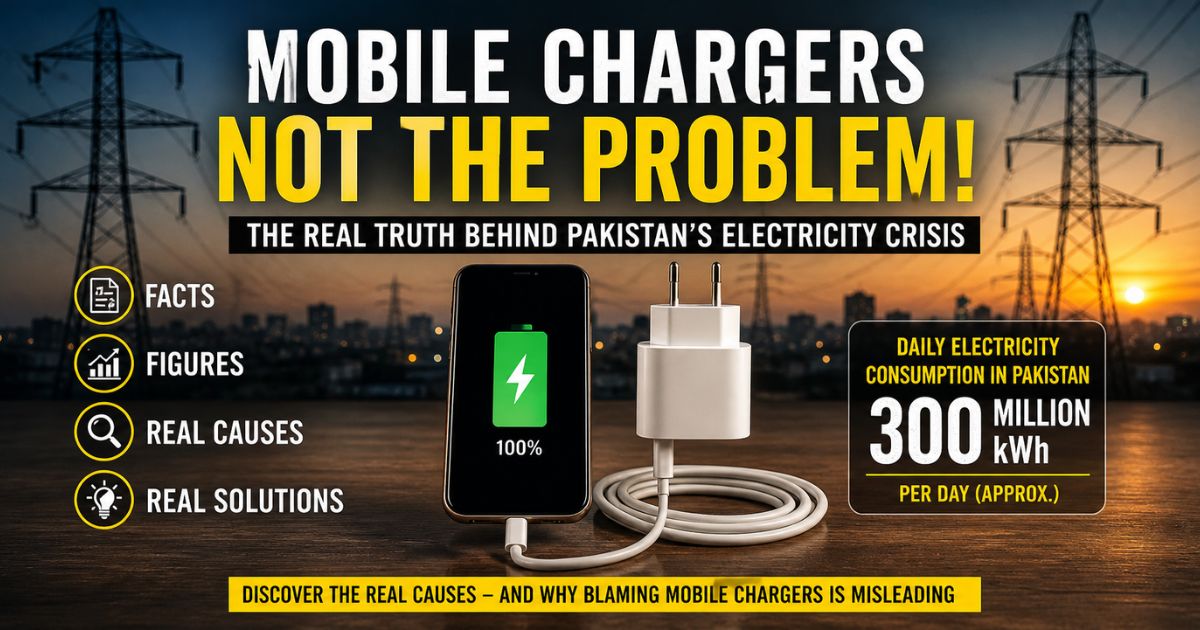
Daily Electricity Consumption in Pakistan: Introduction
Pakistan’s electricity crisis is real, painful, and deeply felt by every household, business, and farmer across the country. Load shedding lasting eight to twelve hours a day, skyrocketing electricity bills, and an overburdened national grid have made electricity a topic of intense national debate and everyone is concerned about daily electricity consumption in Pakistan . In this climate of frustration, it is perhaps unsurprising that any dramatic claim about electricity wastage tend to go viral.
One such claim came recently from Javed Chaudhry, one of Pakistan’s most widely read columnists and news anchor, known for his “Zero Point” column in Daily Express and his long-running show Kal Tak on Express News. In a conversation, Chaudhry stated that mobile phone chargers consume nine crore ,that is, 90 million units of electricity every single day across Pakistan, making them a significant contributor to the country’s energy crisis.
This claim spread rapidly. And why wouldn’t it? It came from a credible, well-respected voice. But credibility is not the same as accuracy, especially when it comes to technical and numerical claims. In this blog, we will examine the daily electricity consumption in Pakistan with real data, apply basic physics and mathematics to test the mobile charger claim, and ultimately identify where Pakistan’s electricity is actually going.
Understanding Daily Electricity Consumption in Pakistan
Before evaluating any specific appliance’s contribution, it is essential to establish a solid baseline. Daily electricity consumption in Pakistan averages approximately 300 million units (kWh) per day, according to data published by the National Electric Power Regulatory Authority (NEPRA) in its annual State of Industry Reports. This figure fluctuates seasonally, rising significantly during summer months due to widespread air conditioning use, and dropping in cooler months. This 300 million unit daily figure is distributed across five major sectors:
- Domestic (Residential) Sector: The residential sector is the single largest consumer of electricity in Pakistan, accounting for roughly 47% of total consumption. Every household running fans, refrigerators, air conditioners, televisions, and lighting contributes to this figure.
- Industrial Sector: Pakistan’s industrial base particularly textiles, cement, steel, and sugar accounts for over 25% of national electricity consumption. Many factories operate on outdated, energy-inefficient machinery, driving consumption higher than necessary.
- Agricultural Sector: Electric tube wells used for irrigation are a massive and often underestimated source of electricity demand. Pakistan’s agricultural sector consumes billions of kilowatt-hours annually, much of it at heavily subsidized rates that discourage conservation.
- Commercial Sector: Shops, plazas, office buildings, hotels, and restaurants collectively account for approximately 8–10% of national electricity use. Poor energy efficiency standards in commercial construction make this figure higher than it should be.
- Government and Public Services: Street lighting, government offices, and public buildings add further to the national grid’s burden often with aging, inefficient equipment.
Understanding this breakdown is the foundation for any honest discussion about daily electricity consumption in Pakistan and where meaningful reforms can actually make a difference.
What Does a Mobile Charger Actually Consume?
To evaluate Javed Chaudhry’s claim scientifically, we need to start with the basic physics of mobile phone chargers. This is not complicated, it involves nothing more than the fundamental electrical formula: “Power = Voltage × Current”. Mobile phone chargers available in Pakistan fall broadly into three categories:
Charger Type | Wattage | AC Current Draw (at 230V) |
Standard Charger | 5W – 18W | 0.10 – 0.25 A |
| Fast Charger | 18W – 45W | 0.20 – 0.40 A |
| High-Power Charger | 65W and above | 0.40 – 0.60 |
The vast majority of Pakistani mobile users use standard or basic fast chargers in the 10–18 watt range. High-power 65W chargers are used almost exclusively with premium flagship smartphones, which represent a small minority of the total device market.
Realistic average daily electricity consumption is approximately 15–20 watts per charger during active charging. Pakistan’s standard grid voltage is 230V AC. Using a conservative average of 0.3 amperes: > Power per charger = 230V × 0.3A = 69 watts.
This is already a generous overestimate for most users. Modern smartphones with efficient chips also reduce charging speed toward the end of the cycle, meaning average power draw over a full session is lower than peak draw.
Typical charging duration is 30 to 45 minutes per day for most users with modern smartphones that charge quickly. Energy per device per day = 69W × 0.5 hours = 34.5 watt-hours = 0.0345 kWh (units). This is the energy consumed by one mobile phone charger in a single day, under generously high assumptions.
The Mathematics: Does the Claim Hold Up?
Now let us scale this to the national level. According to the Pakistan Telecommunication Authority (PTA), Pakistan has approximately 190 million mobile subscribers. However, many of these are feature phones with tiny batteries that consume even less electricity. Let us assume, generously, that 160 million smartphones are being charged every single day. Total daily energy for mobile charging: 160,000,000 devices × 0.0345 kWh = 5,520,000 kWh.
That is approximately 5.5 million units per day Now compare this to the national daily electricity consumption in Pakistan: (5.5 million ÷ 300 million) × 100 = 1.83%. Mobile phone charging accounts for less than 2% of daily electricity consumption in Pakistan. Javed Chaudhry’s claim of 9 crore (90 million) units per day would mean mobile chargers alone consume 30% of Pakistan’s entire electricity supply a day, more than the entire industrial sector,. which is practically as well as simply and mathematically not possible.
Let us now apply an extreme worst-case scenario:- Total devices: 200 million – All using fast chargers (45W average) – Charging time: 1.5 hours per day > 200,000,000 × 0.067 kWh = 13.4 million units per day. Even under this wildly inflated scenario, where every Pakistani charges their phone for 90 minutes daily on a fast charger, mobile charging still represents only 4.5% of daily electricity consumption in Pakistan.
The claim of 9 crore units is off by a factor of 16 to 17 times even under worst-case assumptions. This is not a minor rounding error or a matter of interpretation. It is a fundamental factual inaccuracy.
Daily Electricity Consumption in Pakistan — Who Is The The Real Culprit?
If mobile chargers are not driving Pakistan’s electricity crisis, what is? A serious, honest assessment of daily electricity consumption in Pakistan points to several far more significant factors that deserve urgent public and policy attention.
1. Air Conditioning:
The Summer Giant A single 1.5-ton split air conditioner running for 8 hours per day consumes approximately 2 units (kWh) compared to just 0.035 units for a mobile charger. That is a ratio of roughly 340 to 1. During peak summer months, air conditioners alone are estimated to account for 30–40% of residential electricity demand in urban Pakistan. Cities like Karachi, Lahore, and Multan see temperatures exceeding 40°C for weeks at a time, making AC usage a genuine national-scale electrical burden.
2. Transmission and Distribution Losses:
This is perhaps the most critical and underreported factor in Pakistan’s electricity crisis. According to NEPRA’s State of Industry Report, Pakistan loses an estimated 17 to 22% of all generated electricity through transmission line losses, outdated infrastructure, and electricity theft (known locally as “kunda” connections). At 300 million units of daily consumption, this means approximately 55 to 65 million units are lost or stolen every single day, ten times more than the entire national mobile charging load. Fixing transmission losses alone would save more electricity than eliminating every single phone charger in the country.
3. Industrial Inefficiency:
Pakistan’s industrial sector runs largely on aging, energy-inefficient equipment. Textile mills, brick kilns, and manufacturing plants that have not upgraded their machinery in decades consume far more electricity per unit of output than modern counterparts in competing countries. Industrial energy audits and mandatory efficiency standards could save tens of millions of units daily.
4. Agricultural Tube Wells:
Pakistan’s agricultural sector uses an enormous amount of electricity for groundwater extraction through tube wells. Millions of tube wells operating across Punjab, Sindh, and KPK consume billions of units annually. Much of this consumption happens at heavily subsidized tariff rates, reducing any incentive for farmers to adopt water-efficient irrigation technologies.
5. Inefficient Domestic Appliances:
Millions of Pakistani households still use old, single-speed fans, inefficient fluorescent lighting, decade-old refrigerators without inverter technology, and non-inverter air conditioners. Replacing these with energy-efficient alternatives, as has been successfully done in programs in Bangladesh, India, and China could reduce domestic electricity demand by 15 to 20%.
6. Circular Debt and Supply-Side Failures:
No discussion of daily electricity consumption in Pakistan is complete without addressing the circular debt crisis. Pakistan’s power sector circular debt money owed between power producers, distribution companies, and the government has exceeded Rs. 2.5 trillion. This financial deadlock prevents investment in grid upgrades, new efficient generation capacity, and loss-reduction infrastructure. The result is a system that generates insufficient electricity, loses a fifth of it in transmission, and then charges consumers high tariffs to cover the losses? a vicious cycle that no amount of mobile charger conservation will solve.
Why Misinformation About Energy Crisis Is Dangerous
It may seem harmless for a columnist to overstate the electricity consumption of mobile chargers. After all, the broader message, that Pakistanis should be mindful of electricity use is a worthy one. But factual accuracy matters enormously when it comes to public policy and national resource management.
First, misinformation misdirects public attention. When people believe mobile chargers are a major cause of the electricity crisis, they focus on the wrong solutions. Time and energy that should be directed at demanding grid upgrades, anti-theft enforcement, industrial efficiency standards, and circular debt resolution gets wasted on trivial behavioral changes with negligible impact.
Second, it erodes trust in media. In an era when social media allows real-time fact-checking, inaccurate claims from prominent journalists are quickly exposed and challenged. This damages not only the individual journalist’s credibility but also the broader credibility of Pakistani media, which is already under scrutiny.
Third, it gives policymakers cover. If the public narrative around daily electricity consumption in Pakistan focuses on individual consumer behavior like mobile phones, fans left on, etc, it conveniently deflects attention from systemic failures in generation, transmission, regulation, and governance.
Javed Chaudhry is a seasoned journalist with decades of experience and a genuinely large, loyal readership. His platform carries enormous influence. That influence comes with a responsibility to verify technical claims before broadcasting them to millions of readers and viewers. The tools to do so, basic physics, publicly available NEPRA data, and simple arithmetic are accessible to anyone. This is not a personal attack on Javed Chaudhry. It is a reminder that no matter how senior or respected a journalist may be, facts do not change to accommodate reputation. In the information age, errors of this magnitude will be caught and corrected.
Conclusion and the Way Forward
Daily electricity consumption in Pakistan is a genuine national emergency that demands serious, data-driven solutions. Load shedding, high tariffs, and energy poverty are real problems affecting real people. They deserve honest analysis not viral misinformation. The facts, when examined objectively, are clear: – Pakistan consumes approximately 300 million kWh per day- Mobile phone chargers account for roughly 5.5 million kWh which isbless than 2% of total daily consumption.
The claim of 9 crore units from mobile chargers is off by a factor of 16 times – The real drivers of Pakistan’s electricity crisis are transmission losses (17–22%), air conditioning load, industrial inefficiency, agricultural subsidies, and circular debt.
If Pakistan and Paksitanis are serious about resolving their electricity crisis, the conversation must be grounded in verified data and directed at the genuine causes. That means investing in grid modernization, enforcing anti-theft measures, mandating industrial energy audits, transitioning agriculture to solar-powered tube wells, and restructuring the circular debt. Mobile phone chargers, contributing less than 2% to national electricity consumption, are not the enemy. Misinformation is.
(Author’s Note: While Pakistan’s electricity crisis is largely driven by structural issues , the impact is also felt directly at the household level through rising monthly expenses. For many families, managing these costs has become a survival strategy rather than a choice. If you are trying to reduce your monthly financial burden, you may also find our detailed blog on how to save money in Pakistan helpful, where we explain practical ways to control everyday expenses including utility bills and household budgeting.
Beyond saving money, some readers may also be looking for ways to increase income to better handle rising electricity and living costs. In that case, our article on best side business ideas in Pakistan explores realistic and low-investment opportunities that can help you build an additional income stream.
Interestingly, many people also overlook small but frequent leaks in their monthly budget, such as telecom expenses. For example, hidden charges and unnecessary deductions can quietly add up over time. You can read our analysis on mobile balance deductions in Pakistan to understand how these issues happen and how to avoid them effectively.)

https://www.threads.com/@adilawan9298