
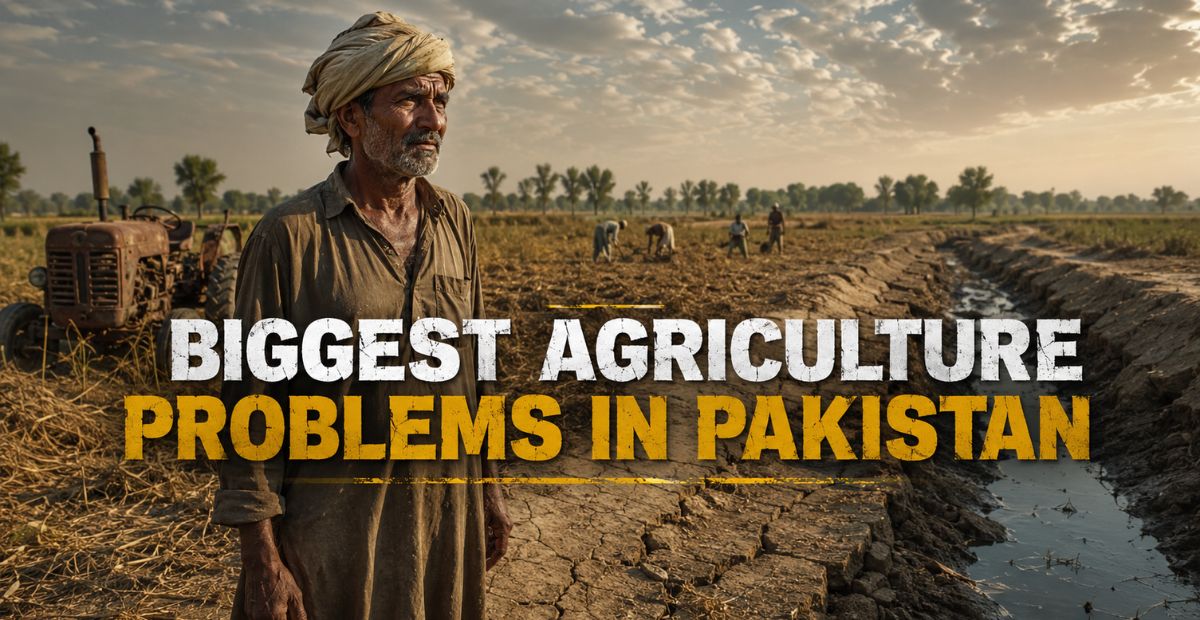
Introduction Of Biggest Agriculture Problems in Pakistan
In the United States, only 2.6 million people are involved in farming and they produce crops worth $1.055 trillion annually. In Pakistan, 90 million people are associated with agriculture and produce crops worth only $50 billion annually.
Just imagine the scale of this difference. This alone explains the biggest agriculture problems in Pakistan.
Pakistan has roughly 35 times more people working on farms, yet its entire agricultural output is barely 5% of what American farmers generate. This is not just a statistics problem. It reflects decades of poor policy, ignored technology, broken infrastructure, and a farming system that has stayed almost unchanged since the 1960s.
Agriculture is the backbone of Pakistan’s economy. It contributes around 22% to the GDP and employs nearly 37% of the country’s labor force. Yet Pakistani farmers struggle to grow enough food for their own population, let alone compete internationally. The biggest agriculture problems in Pakistan go far deeper than dry land or lack of rain. They are rooted in systems that were never fixed.
This article breaks down the core reasons why Pakistani agriculture underperforms so badly, using real examples, local context, and clear facts.
Actual Biggest Agriculture Problems in Pakistan
Why Pakistan’s Agricultural Output Lags So Far Behind
Before explaining individual problems, it is necessary to understand the structure. In the United States, farming is treated like an industry. Farmers use GPS-guided tractors, soil sensors, satellite imaging, and predictive software. A single wheat farmer in Kansas might manage 5,000 acres using a small team and advanced machinery.
In Pakistan, a typical farmer owns 2 to 5 acres. He uses the same ox-drawn plow his grandfather used. He buys seeds from the local market without knowing their germination rate. He floods his field with water because no one taught him drip irrigation. Then he sells his harvest to a middleman who takes a 40 to 60% cut of the profits.
This is the baseline reality behind the numbers. Now here are the specific problems that create this gap.
Water Mismanagement — One of The Biggest Agriculture Problems in Pakistan
Water is Pakistan’s most critical agricultural resource. The Indus River system is one of the largest irrigation networks in the world, stretching over 56,000 miles of canals. But the way Pakistan uses this water is shockingly inefficient.
Pakistan’s average water use efficiency in farming is around 40 percent. That means 60 percent of irrigation water is lost through evaporation, seepage, and poor distribution. Compare that to Israel, where water efficiency in agriculture exceeds 90 percent using drip and sprinkler systems.
The main reasons for this waste are:
Pakistan still relies heavily on flood irrigation, where fields are simply flooded with water. This method, while simple, wastes enormous amounts of water and also waterlogs the soil over time, making it less fertile. In Sindh and southern Punjab, millions of acres have become waterlogged because of this practice. The WAPDA (Water and Power Development Authority) estimates that over 6 million hectares of land in Pakistan are affected by waterlogging and salinity.
The canal system itself was built during British colonial times. Over 100 years later, most of these canals have not been properly renovated. Water theft, broken headworks, and political favoritism in water distribution mean that tail-end farmers those at the far end of the canal often receive only 30 percent of their entitled water supply.
In areas dependent on groundwater, the situation is equally troubling. Tube wells now extract water from rapidly depleting aquifers. In Baluchistan, many traditional karez (underground water channels) have dried up entirely because tube wells nearby dropped the water table.
Drip irrigation exists and is proven to work. Pakistan’s own government schemes have subsidized it multiple times. But adoption rates remain below 5 percent because farmers lack the capital to invest, lack training to operate it, and often lack confidence that it will work on their specific crops.
Land Fragmentation and the Feudal System Are Major Biggest Agriculture Problems in Pakistan
Land ownership in Pakistan is deeply unequal and the structure of that inequality creates two separate crises.
On one side, you have feudal landowners wadera and Chaudhry class who own thousands of acres but leave much of it uncultivated or use it for low-effort crops like sugarcane, which they can politically protect through subsidized pricing. Research by the Pakistan Institute of Development Economics (PIDE) shows that roughly 5 percent of landowners control over 64 percent of agricultural land.
On the other side, you have millions of small farmers over 65 percent of farming households own less than 5 acres who cannot afford inputs, cannot access credit, and cannot mechanize their operations at that scale. A 2-acre farm simply cannot justify the cost of a tractor or a precision irrigation system.
Then there is the inheritance problem. When a 10-acre farm is divided among four sons, each generation inherits smaller pieces. Eventually, farms become too small to be economically viable at all. This is called land fragmentation, and it is one of the structural reasons why Pakistan’s agriculture cannot scale.
Land reforms have been attempted Zulfikar Ali Bhutto’s reforms in 1972 redistributed some land, but these reforms were largely undone, poorly implemented, or worked around by powerful landowners who transferred land to family members. No serious land reform has happened since.
The result is a feudal agriculture system that resists modernization. Feudal landlords often provide informal loans to tenant farmers (haris) at exploitative rates, keeping them in cycles of debt. A haris farmer in interior Sindh who borrows money for seeds and fertilizer at 30 to 40 percent annual interest often ends up giving most of his crop back to the landlord just to service that debt.
Lack of Modern Technology Is Among the Biggest Agriculture Problems in Pakistan
This is the area where the comparison with the United States becomes most glaring.
American farmers use real-time soil data to apply fertilizer only where needed a technique called variable rate application. Pakistani farmers apply fertilizer uniformly across an entire field, which means excess in some places (causing chemical runoff) and deficiency in others (reducing yield).
In the US, drones are used to survey crop health, detect pest outbreaks early, and even spray pesticides precisely. In Pakistan, pest detection is usually done visually when damage is already visible by which point significant losses have already occurred. The 2019 locust crisis is a painful example. Locusts entered from Iran and Balochistan in mid-2018, but the alarm was raised seriously only in late 2019, by which time they had destroyed crops across Sindh and Punjab worth billions of rupees.
Seed quality is another technology gap. Pakistan’s cotton crop, once the finest in the world, has been devastated partly because of poor seed stock. The introduction of unauthorized Bt cotton seeds during the early 2000s temporarily boosted yields, but without proper regulation or research support, farmers now struggle with seeds that have lost their pest resistance without replacement varieties being developed in time.
Agricultural research spending in Pakistan is less than 0.5 percent of agricultural GDP. In countries like Brazil and China, it exceeds 1.5 percent and is directly responsible for significant yield improvements. Pakistan’s agricultural universities produce thousands of graduates annually, but most research stays in journals rather than reaching fields.
One clear success case worth studying is CIMMYT’s work in Pakistan. The International Maize and Wheat Improvement Center worked with Pakistani researchers to develop drought-tolerant wheat varieties. Farmers who adopted these varieties in rainfed areas saw yields increase by 20 to 30 percent. But this program reached only a fraction of the farmers who needed it.
Post-Harvest Losses and Market Failures Multiply the Biggest Agriculture Problems in Pakistan
Even when farmers manage to grow a good crop, they often lose a significant portion of it before it reaches consumers and then get paid very little for what does make it to market.
Pakistan loses an estimated 20 to 40 percent of its fruits and vegetables after harvest due to lack of cold storage, poor roads, and inadequate packaging. According to the Food and Agriculture Organization (FAO), Pakistan’s post-harvest losses in horticulture alone exceed $1 billion annually. Tomatoes grown in Baluchistan rot in trucks because there are no cold storage facilities along the route to Karachi. Mangoes from Multan arrive bruised in international markets because they travel in open wooden crates rather than climate-controlled containers.
The market system works against farmers in multiple ways. Middlemen called arhtis in local markets control pricing in wholesale markets called mandis. A farmer brings his produce to the mandi and the arthis sets the price. The farmer has no alternative buyer, no price information, and no negotiating power. Studies by the International Food Policy Research Institute (IFPRI) show that Pakistani farmers receive as little as 30 to 40 percent of the final consumer price for vegetables, compared to 60 to 70 percent in more developed supply chains.
There is also an almost complete absence of contract farming at scale. In Thailand and Vietnam, companies contract directly with farmers, guaranteeing a price before planting. This gives farmers confidence to invest in quality inputs. In Pakistan, contract farming exists in pockets some tobacco and sugarcane companies do it but it is not widespread and farmers have little legal protection even in those arrangements.
Cold chain infrastructure barely exists outside major cities. Pakistan has fewer than 100 large-scale cold storage facilities for a country producing billions of dollars worth of perishable fruits and vegetables annually. China, for context, has over 4,000 large cold storage facilities.
Loans and Agricultural Finance Failures Worsen the Biggest Agriculture Problems in Pakistan
Farming requires money upfront. Seeds, fertilizer, water, labor all must be paid for before the crop is even harvested. Without affordable credit, small farmers cannot invest in better inputs, and without better inputs, yields stay low.
Pakistan’s formal agricultural credit system is severely under-developed relative to need. Zarai Taraqiati Bank Limited (ZTBL), the main agricultural development bank, along with commercial banks, disburses roughly PKR 1.8 trillion in agricultural credit annually. That sounds large until you realize that only about 25 to 30 percent of Pakistani farmers have ever accessed formal credit.
The rest depend on informal sources local moneylenders and arhtis who charge interest rates between 24 and 60 percent annually. At those rates, taking a loan for better seeds means giving up almost all yield gains just to repay the debt.
Why don’t more farmers use banks? The reasons are practical and structural. Banks require collateral, usually land ownership documents, and millions of tenant farmers and sharecroppers have no land title to pledge. Bank branches are often in cities, not villages. Loan processing takes weeks, but a farmer needs money before the planting window closes. Loan sizes offered by commercial banks are often too large for small farmers who only need PKR 20,000 to 50,000 for a single season.
Microfinance institutions like Kashf Foundation and NRSP have tried to fill this gap, but their agricultural lending portfolio is small and interest rates, while lower than moneylenders, are still high by any standard.
The Kisan Card scheme launched by the Punjab government in recent years attempted to address this by providing subsidized credit on a debit card to registered farmers. Early reports showed promising uptake in Punjab. But without a robust system to verify usage and monitor outcomes, these schemes often benefit politically connected larger farmers over the smallholders who need them most.
Climate Change Is Accelerating the Biggest Agriculture Problems in Pakistan
Pakistan is ranked among the top ten countries most vulnerable to climate change, despite contributing less than 1 percent of global greenhouse gas emissions. For agriculture, this is increasingly catastrophic.
The 2022 floods are the most dramatic recent example. A combination of record monsoon rains and glacial melt inundated one-third of Pakistan’s total land area. Over 2 million acres of crops were destroyed. Sindh and Balochistan, both heavily agricultural provinces, lost cotton, rice, and vegetable harvests entirely in many areas. Total agricultural losses were estimated at over $3.7 billion by the government and UN agencies.
But climate change creates chronic problems alongside these dramatic disasters. Glaciers in the Karakoram and Hindukush feed rivers that irrigate millions of acres. As glaciers retreat, seasonal water flows become unpredictable floods in some years, severe shortages in others. Farmers who have relied on predictable river flows for generations now face radical uncertainty.
Rising temperatures are pushing the wheat growing season. Wheat requires cool temperatures during grain filling, and studies by the International Center for Agricultural Research in the Dry Areas (ICARDA) show that for every 1°C increase in temperature during this period, wheat yields in Pakistan could decline by 4 to 6 percent. Average temperatures in wheat-growing areas of Pakistan have already risen by approximately 0.5°C since 1990.
Heat stress is also increasing water demand at a time when water supply is decreasing. This double pressure needing more water while having less is already pushing farmers in parts of Thar and Cholistan to abandon farming entirely.
Adaptation requires investment in drought-tolerant seed varieties, better water storage infrastructure, and weather-based crop insurance. Pakistan has some programs in all these areas, but implementation is fragmented and underfunded compared to the scale of the problem.
What Pakistan Needs to Do: A Realistic Path Forward
The problems described above are large but not unsolvable. Many countries have faced similar structural barriers and improved significantly within one or two generations.
China’s agricultural transformation between 1978 and 2000 is the most relevant example. By decollectivizing land, giving farmers secure tenure, investing in rural roads and storage, and subsidizing inputs intelligently, China moved from chronic food shortages to food surplus within 20 years. The key was sustained, coordinated policy rather than one-off schemes.
For Pakistan, several specific interventions are both feasible and urgent.
On water, the government needs to mandate and subsidize the transition from flood to drip and sprinkler irrigation. This requires farmer training programs at the union council level, not just provincial offices. Countries like Morocco and Egypt have done this at scale with significant yield results.
On land, tenant farmers need legal protections and enforceable contracts so that they can invest in their land without fear of arbitrary eviction. This does not require a complete redistribution of land just secure tenure rights for those who farm it.
On technology, agricultural extension workers government officials who are supposed to bring technical knowledge to farmers need to be retrained, redeployed to villages, and given digital tools. Pakistan has roughly one extension worker per 2,000 farmers, when international recommendations suggest one per 500 to 800. Vietnam doubled its extension workforce in the 1990s and saw rice yields increase by over 30 percent within a decade.
On markets, building digital price platforms where farmers can check real-time mandi prices before deciding where to sell would reduce arthis’ informational advantage. India’s eNAM system is a working example of how this can be done at scale.
On credit, moving toward mobile-based agricultural credit with simple documentation requirements would bring millions of smallholders into the formal system. Kenya’s M-Pesa agricultural credit model, adapted to Pakistan’s context, could significantly improve access.
None of these are revolutionary ideas. Most have been piloted somewhere in Pakistan already. The failure has not been lack of ideas it has been lack of consistent implementation, proper monitoring, and political will to challenge the interest groups that benefit from the current broken system.
Conclusion: The Biggest Agriculture Problems in Pakistan Are Solvable, But the Clock Is Ticking Fast
The gap between American and Pakistani agricultural productivity is not a story of natural disadvantage. Pakistan has fertile land, a large river system, and a hardworking farming population. The gap is a story of systems irrigation systems that waste water, market systems that exploit farmers, credit systems that exclude the poor, and policy systems that protect landowners over land workers.
The biggest agriculture problems in Pakistan water waste, land inequality, technology gaps, post-harvest losses, limited credit, and climate vulnerability are interconnected. Solving one without addressing the others will produce limited results. But that does not mean nothing should be done until everything can be fixed at once. Incremental, targeted interventions that are properly funded and honestly monitored can produce real improvement.
Pakistan’s farmers have shown resilience over generations. With the right tools, the right price information, and the right investment in their fields, they are capable of producing far more than $50 billion annually. The question is whether Pakistan’s policy makers and society will choose to build those systems or keep managing the decline.
References:
- Pakistan Bureau of Statistics. (2023). *Pakistan Economic Survey 2022–23: Agriculture Chapter.* Government of Pakistan.
- Food and Agriculture Organization of the United Nations (FAO). (2022). *Post-Harvest Losses in Pakistan: Assessment and Recommendations.* FAO Regional Office for Asia and the Pacific.
- Pakistan Institute of Development Economics (PIDE). (2021). *Land Distribution and Agricultural Productivity in Pakistan.* PIDE Working Papers.
- World Bank. (2022). *Pakistan Floods 2022: Post-Disaster Needs Assessment.* The World Bank Group.
- International Food Policy Research Institute (IFPRI). (2020). *Agricultural Market Efficiency and Farmer Welfare in Pakistan.* IFPRI Discussion Paper.
- WAPDA. (2022). *Waterlogging and Salinity in Pakistan: Situation and Remedies.* Water and Power Development Authority Pakistan.
- State Bank of Pakistan. (2023). *Agricultural Credit Statistics 2022–23.* SBP Agricultural Finance Department.
- ICARDA. (2021). *Impact of Climate Change on Wheat Production in South Asia.* International Center for Agricultural Research in the Dry Areas.
- USDA Economic Research Service. (2023). *U.S. Farm Sector Financial Indicators, 2023 Forecast.* United States Department of Agriculture.
- Asian Development Bank (ADB). (2021). *Strengthening Agricultural Value Chains in Pakistan.* ADB Technical Assistance Report.
Also worth your time (Author’s Note):
If this topic got you thinking, chances are you will find just as much value in some of our earlier reads. We cover everything from global trends and policy decisions to the everyday stories that actually explain how the world works and why it works that way. Below are a few pieces that connect well with what you just read:

https://www.threads.com/@adilawan9298