
Introduction: Understanding The Paisa Rounding Trick in Pakistan
The paisa rounding trick in Pakistan is one of those everyday financial realities that most people experience but rarely notice or question. Whether you are buying fuel at a petrol station, paying electricity bills, or settling gas charges, you may have observed that the final amount is slightly different from the exact calculated figure. These small differences are present in almost every transaction across Pakistan.
In simple terms, the paisa rounding trick in Pakistan happens because modern billing systems calculate prices in exact decimal values, but payments are collected in whole rupees. Since small coins like paisa are no longer in circulation, these decimal amounts cannot be fully paid, and therefore they are rounded. Although the difference seems very small at an individual level, it becomes meaningful when applied across millions of daily transactions.
Interestingly, this kind of “hidden micro-adjustment” is not unique. Similar patterns can be seen in other financial systems, such as mobile balance deductions in Pakistan, where users often lose small amounts without realizing it. Over time, these small values accumulate and create a noticeable financial impact on consumers.
👉 Related: Mobile Balance Deduction in Pakistan – Hidden Charges Explained
Why the Paisa Rounding Trick in Pakistan Exists Even In 2026?
The paisa rounding trick in Pakistan exists mainly due to a mismatch between digital pricing systems and physical currency usage. Pakistan still follows a decimal currency system where 1 rupee equals 100 paisa. This system is essential for accurate financial calculations, taxation, imports, exports, and wholesale pricing.
However, the problem begins at the payment stage. Since small coins are no longer used in daily life, consumers cannot pay exact decimal amounts. This creates a gap between calculated prices and actual payments.
Lack of Small Coins in the Economy
In the past, coins such as 1, 2, 5, 10, 25, and 50 paisa were commonly used. These allowed precise payments without rounding. But today, these coins have disappeared from circulation, making decimal payments impossible in physical transactions. As a result, prices like:
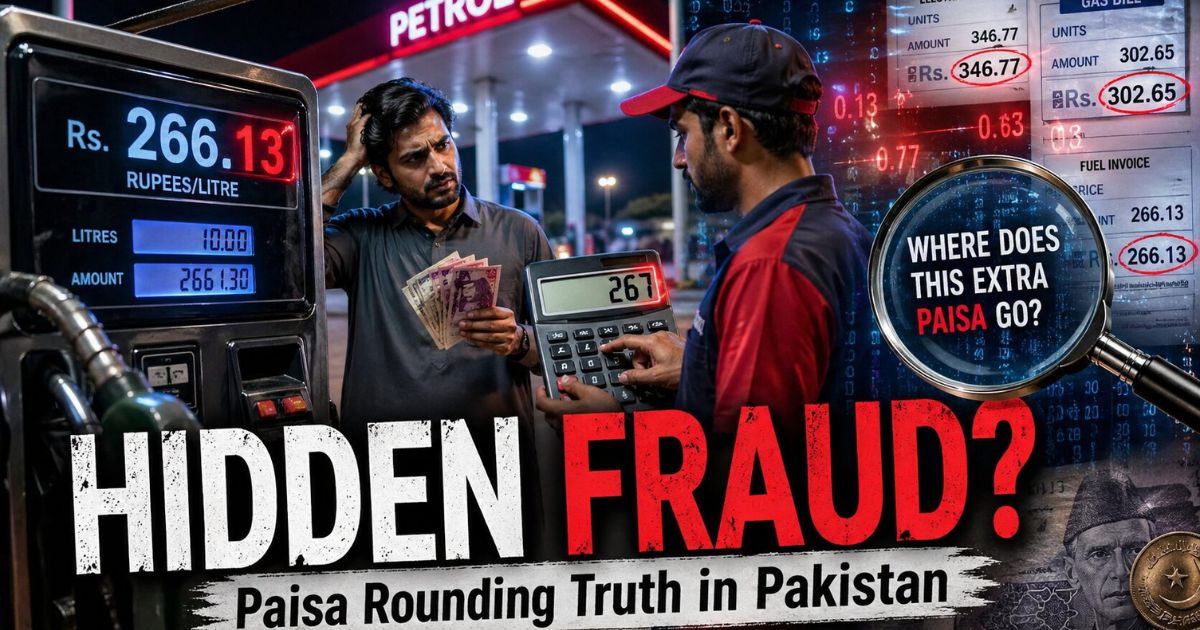
- Petrol: Rs. 266.13 per litre
- Electricity: Rs. 34.77 per unit
- Gas: Rs. 302.65 per unit
are automatically rounded to the nearest rupee during payment.
This rounding is the core of the paisa rounding trick in Pakistan in fuel and utility billing systems.
Impact of the Paisa Rounding Trick in Pakistan on Daily Life
At first glance, the difference created by rounding appears very small. It is often less than one rupee per transaction. However, when multiplied across millions of transactions every day, the overall impact becomes significant.
Where the Paisa Rounding Trick is Seen Most Frequently In Pakistan
The paisa rounding trick in Pakistan appears in many sectors of daily life, including:
- Fuel stations and petrol pricing
- Electricity and gas billing systems
- Grocery and retail POS systems
- Online shopping platforms
- Mobile and digital payment systems
For example, if petrol is priced at Rs. 266.13 per litre and a customer pays Rs. 267, the difference is Rs. 0.87. Individually, this seems irrelevant. But when millions of litres are sold daily across Pakistan, this small difference becomes a large cumulative value.
This hidden financial behavior also reflects broader economic pressure on households, where small costs gradually build up and affect monthly budgets.
This is similar to how rising prices of essential goods impact purchasing decisions, such as when families evaluate whether cars like the Suzuki Alto in Pakistan are still affordable in today’s inflation-driven market.
👉 Related: Suzuki Alto Price in Pakistan – Is It Still Affordable?
Is the Paisa Rounding Trick in Pakistan Fraud or System Limitation?
Many people assume that the paisa rounding trick in Pakistan is a hidden form of fraud or unfair deduction. However, this assumption is not entirely correct. In reality, it is mostly a system limitation rather than intentional exploitation.
How the System Actually Works
The trick exists because:
- Billing systems calculate exact decimal values
- Payments are collected only in whole rupees
- There is no unified national rounding policy
Because of this gap, different companies apply different rounding methods. Some round up, some round down, and some use nearest-value rounding. This inconsistency creates confusion among consumers.
Therefore, the paisa rounding trick in Pakistan should be understood as a structural inefficiency in the financial system rather than a planned financial scam.
Economic and Social Effects of the Paisa Rounding Trick in Pakistan
Although the difference per transaction is small, the cumulative effect across the economy is much larger. Pakistan processes millions of daily transactions in fuel, utilities, and retail sectors. Even tiny rounding differences can add up significantly over time.
This issue is part of a broader pattern of financial stress in society. Rising inflation, hidden charges, and cost-of-living increases all contribute to economic pressure on households.
These financial pressures also connect with social structures. For example, in many households, especially those following the joint family system in Pakistan, shared financial responsibilities can increase stress and reduce financial flexibility. Financial stress also indirectly affects health and well-being. Economic pressure, combined with lifestyle challenges, is one of the factors linked with declining health outcomes in Pakistan.
👉 Related: Disadvantages of Joint Family System in Pakistan Today
Why Paisa is Still Used in Pakistan’s Financial System
Even though paisa coins no longer exist, the decimal system is still used in financial calculations. This is because precise values are necessary for taxation, banking, trade, and government pricing systems.
Removing paisa entirely would require a complete redesign of Pakistan’s financial infrastructure, including software, banking systems, and accounting methods. This is not practical in the short term, which is why the paisa rounding trick in Pakistan continues to exist.
Solutions to Reduce the Paisa Rounding Trick in Pakistan
There are several practical solutions that can reduce the impact of the paisa rounding trick in Pakistan:
- Standard Rounding Policy
A national rule should be introduced so all companies follow the same rounding method.
- Digital Payment Expansion
Digital banking and mobile wallets allow exact paisa-level transactions, removing the need for rounding.
- Simplified Pricing System
Businesses can move toward whole-rupee pricing to avoid confusion.
- Public Awareness
Consumers should be educated about how billing systems work to reduce misunderstanding and mistrust.
Conclusion: A Small Trick with a Big Impact
The paisa rounding trick in Pakistan may seem like a small technical detail, but it reflects a deeper gap between modern digital systems and outdated currency practices. While it is not a scam, it highlights inefficiencies in financial structures that affect millions of people daily.
Understanding this trick helps consumers become more aware of how pricing works in Pakistan and how small financial differences accumulate over time. When seen alongside other everyday financial challenges, such as mobile balance deductions, rising living costs, and affordability issues, it becomes clear that small leaks in the system collectively shape the larger economic experience of ordinary people.
Frequently Asked Questions (FAQs)
- What is the paisa rounding trick in Pakistan?
It is the small difference that occurs when decimal prices are rounded to whole rupees due to the absence of paisa coins.
- Is the paisa rounding trick legal in Pakistan?
Yes, it is legal because it is necessary for practical transactions, although no fixed national rounding rule exists.
- How much money is lost due to the paisa rounding trick?
Individually very small, but collectively across millions of transactions, the amount becomes significant.
- Is it similar to mobile balance deductions?
Yes, both involve small hidden amounts that accumulate over time and affect consumers collectively.
- Can digital payments remove this trick?
Yes, digital payments can handle exact decimal values, reducing or eliminating rounding differences.

https://www.threads.com/@adilawan9298